The Challenge of Challenge: A Practical Framework for Adviser Risk and Client Decision-Making

Introduction
Most financial planners recognise that good advice is about more than technical expertise.
Our role is not simply to provide information or implement recommendations. We are often required to challenge assumptions, test decisions and help clients think more clearly about the consequences of their choices.
Yet this creates a tension.
Challenge too little and clients may proceed with decisions that expose them to unnecessary risk.
Challenge too much and advisers risk damaging trust, creating resistance or unintentionally replacing client autonomy with their own judgement.
The question is not whether advisers should challenge clients.
The question is how.
The Missing Conversation
Many professional discussions focus on client risk.
We assess investment risk, capacity for loss, protection needs, estate planning risks and tax implications. Processes, regulations and suitability requirements are built around identifying and managing these risks.
Less attention is often given to adviser risk.
Not business risk or compliance risk, but the risk created by how we interact with clients.
Every adviser faces situations where they must decide:
Should I push further?
Have I challenged enough?
Am I becoming too directive?
Am I avoiding a difficult conversation?
Is the client making an informed choice or simply choosing what feels comfortable?
These decisions are rarely black and white.
They exist in a space where ethics, behavioural finance, professional judgement and client relationships intersect.
Three Sources of Risk
Through reflection, professional practice and postgraduate study, I have found it useful to think about three interconnected sources of risk.
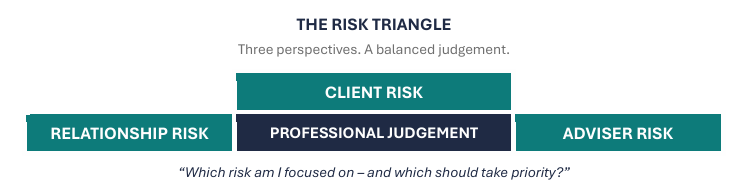
The Risk Triangle
Risk to the Client
The potential for financial, practical or emotional harm resulting from a decision.
Examples include:
Unsustainable spending.
Delayed estate planning.
Failure to insure key risks.
Excessive investment concentration.
Inaction where action is required.
Risk to the Relationship
The possibility that challenge damages trust, rapport or engagement.
Clients may feel judged, criticised or misunderstood if challenge is poorly delivered.
Without trust, even technically excellent advice may fail to influence behaviour.
Risk to the Adviser
The professional and ethical risk of either acting too passively or becoming overly paternalistic.
Advisers must balance their responsibility to provide robust challenge while respecting the client's right to make their own decisions.
This tension exists at the heart of financial planning.
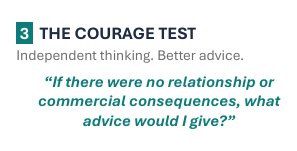
The CARE Framework
To help navigate this tension, I developed a simple framework which I call CARE.
CARE is not intended to be a compliance process or a replacement for professional judgement.
Instead, it acts as a thinking tool for difficult client situations.
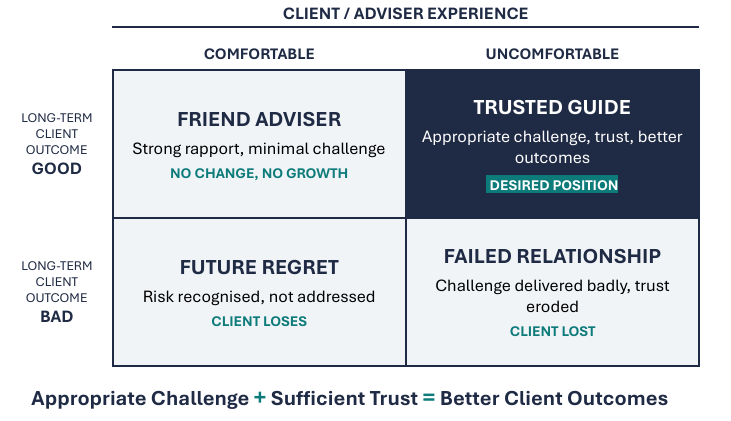
The CARE model
C - Challenge with Care
Challenge should be purposeful rather than confrontational.
The aim is not to prove the adviser is right.
The aim is to improve the quality of the client's decision-making.
A - Awareness of Risk
Before deciding how strongly to challenge, advisers should consider the three dimensions of risk:
Risk to the client.
Risk to the relationship.
Risk to the adviser.
Each situation requires a different balance.
R - Respect for the Client
Clients have the right to make decisions that advisers may not personally agree with.
Respecting autonomy does not mean avoiding challenge.
It means recognising that informed client decisions remain the client's decisions.

E - Evidence-Led Advice
Challenge is most effective when supported by evidence rather than opinion.
Cashflow modelling, behavioural observations, technical knowledge and scenario analysis can all help clients understand the consequences of their choices.
Evidence creates clarity.
Clarity improves decision-making.
From Framework to Process
The framework provides a way of thinking.
The process provides a way of acting.
When facing a difficult client decision, I increasingly find myself working through four questions:
1. What is the Client Risk?
What harm could occur if this decision proceeds unchanged?
2. How Significant is the Risk?
Is this a minor preference issue or a potentially significant financial planning concern?
3. What Level of Challenge is Appropriate?
Should I:
Inform?
Educate?
Explore?
Recommend?
Escalate challenge?
Not every situation requires the same response.
4. Has the Client Made an Informed Decision?
Ultimately, the goal is not adviser agreement.
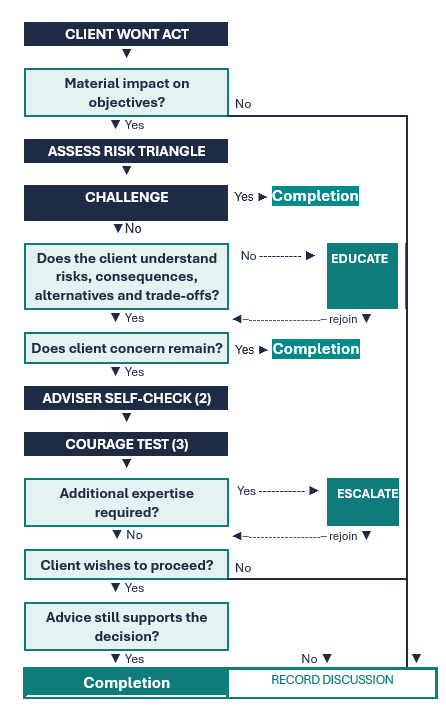
The Risk Challenge Process
The goal is informed client choice.
What This Changes in Practice
The most significant shift for me has been recognising that good financial planning is not simply about being liked.
Many advisers, myself included, naturally prioritise rapport and relationship building.
These are essential skills.
However, there are moments when professionalism requires us to move beyond comfort and ask more challenging questions.
Sometimes the highest quality advice is delivered through uncomfortable conversations.
The challenge is ensuring those conversations are conducted with empathy, evidence and respect.
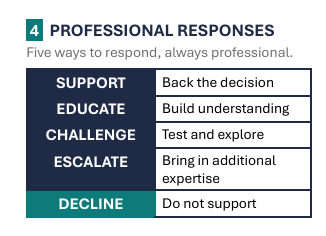
Potential Responses
A Framework, Not a Solution
This framework is still developing.
It is not presented as a finished model or definitive answer.
Rather, it represents an attempt to provide structure to a challenge faced by almost every adviser: balancing client autonomy with professional responsibility.
As financial planning continues to evolve beyond technical advice and towards behavioural coaching, life planning and decision support, I believe this balance will become increasingly important.
The best advisers will not simply be those who know the most.
They will be those who know when to challenge, how to challenge and how to help clients make better decisions while remaining firmly in control of their own lives.
Author's Note
The CARE Framework emerged from a combination of professional practice, behavioural finance research and reflection during my STEP Postgraduate Diploma in Private Wealth Advice studies. I would welcome feedback, challenge and discussion from fellow advisers and planners as the framework continues to evolve.
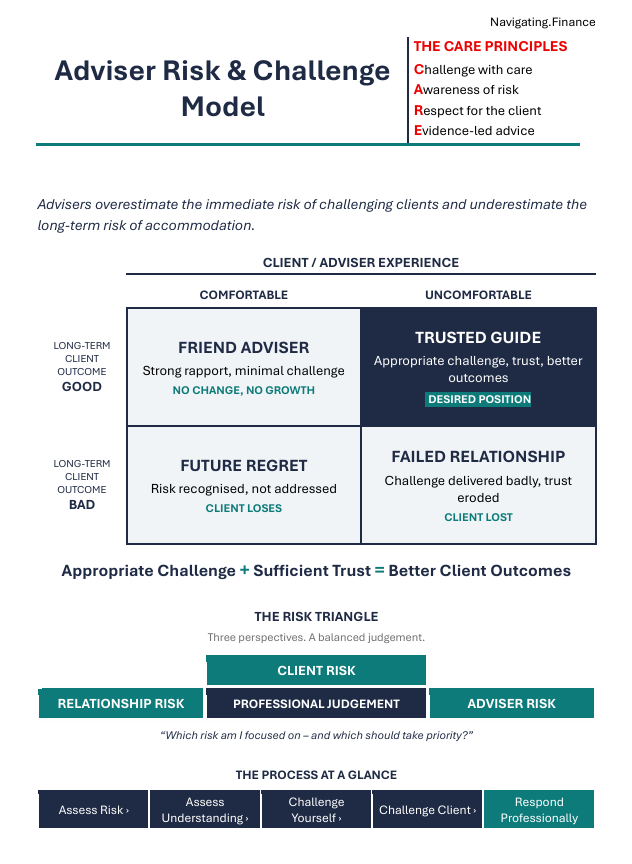
Adviser Risk & Challenge Model
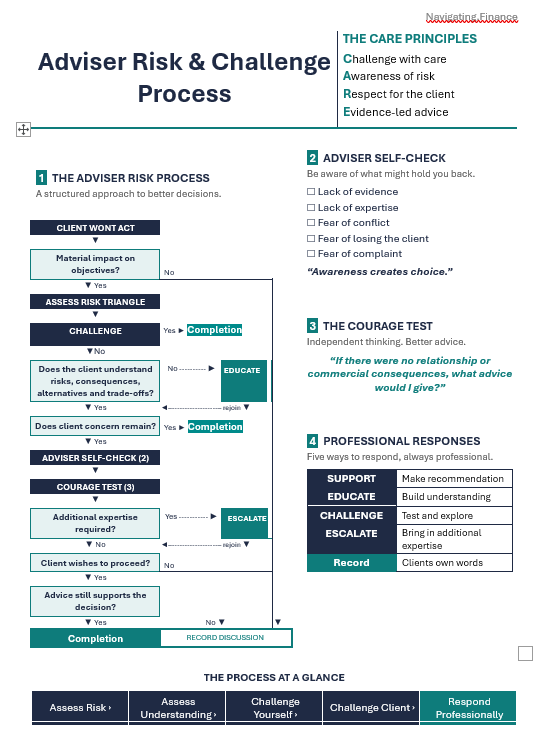
Adviser Risk and Challenge Process